9th November 2026
| We will meet at Castellaneta station, where we will meet with the guide and start the trip with a brief briefing and then we will visit Castellaneta underground together with the guides of the Friends of the Gravine Land Association. The day will end with a dinner based on typical local products. |
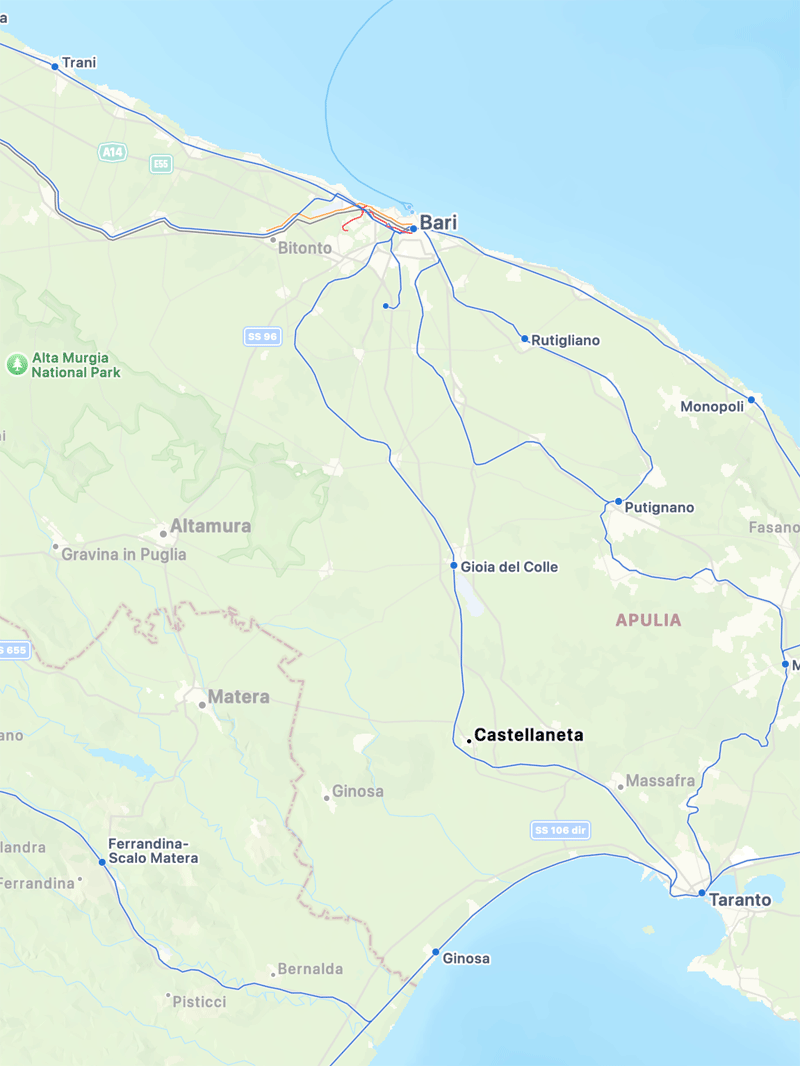
| Castellaneta, a comune of around 15,784 inhabitants in the province of Taranto, sits above a dramatic ravine system carved into the Apulian plateau — a geological fact that has determined the town’s layout, its defensive logic, and the views that define it today. Visitors drawn to this corner of southern Puglia often arrive expecting little and leave with a much clearer understanding of how geology and medieval settlement patterns intersect. Knowing what to see in Castellaneta means starting not with a church or a piazza, but with the land itself. The ravines cutting through the limestone plateau directly below the town centre are Castellaneta’s most geologically significant feature. Formed over millennia by erosion, these canyon-like formations — locally called gravine — drop sharply from the inhabited ridge. Rock-cut cave dwellings and ancient rupestrian chapels are visible within the ravine walls, a pattern of habitation shared across the broader Gravine di Puglia Natural Park. |
https://www.villagesitaly.com/villages/castellaneta/
Cattedrale di Santa Maria Assunta
The cathedral stands on the highest ground of the old town, its origins rooted in the Norman diocese established in the eleventh century. The current structure reflects successive interventions across the medieval and baroque periods. Its facade and interior preserve elements from different architectural campaigns, making it a legible record of the town’s ecclesiastical continuity across roughly nine hundred years. |
https://www.villagesitaly.com/villages/castellaneta/
Museo Rodolfo Valentino
Dedicated to the town’s most internationally famous native, this museum documents the life and career of Rodolfo Valentino through archival materials, photographs, and period objects. Valentino was born on 6 May 1895 in a house in Castellaneta’s historic centre. The museum functions as the primary institutional point of reference for his biography and for understanding his transition from an obscure southern Italian town to 1920s Hollywood stardom. |
https://www.villagesitaly.com/villages/castellaneta/
Historic Centre and Belvedere
The old town’s street plan follows the logic of a ridge settlement, with narrow lanes running parallel to the ravine edge. The belvedere — the panoramic terrace overlooking the gravine — offers an unobstructed view down into the canyon system and across toward the Ionian coastal plain. This vantage point makes the relationship between the town’s elevation, roughly 250 metres above sea level, and the surrounding landscape immediately legible. |
https://www.villagesitaly.com/villages/castellaneta/
Palazzo Marchesale
The feudal palace occupying part of the historic centre reflects the town’s history under various noble families who held control of the territory during the Angevin and subsequent Spanish periods of southern Italian governance. The structure, typical of Apulian feudal architecture in its scale and position relative to the urban fabric, has undergone transformations across the centuries and today stands as one of the more substantial civil buildings in the old town. |
https://www.villagesitaly.com/villages/castellaneta/
|